Part 7: The treatment atlas
Swedana is one of the most misunderstood parts of Ayurveda.
People hear “heat therapy” and imagine something intense, like sweating it out until you feel empty.
Classical Ayurveda is calmer than that.
Swedana is controlled therapeutic warmth. It is used to support movement, ease stiffness, and reduce the “stuck” feeling that can sit in tissues and channels when the system is heavy, tight, or strained.
Heat is a tool, not a badge.
Used well, it can feel loosening, relieving, and settling.
Used at the wrong time, it can feel draining, irritating, or too much.
That is why Swedana belongs inside assessment, not inside a generic spa menu.
A gentle safety note
This chapter is educational. It does not prescribe treatment.
Avoid heat therapies, or only do them with clinical supervision, if any of these are true:
- Fever, infection, acute illness, diarrhoea, vomiting
- Pregnancy or postpartum changes without clear clinician guidance
- Severe dehydration or heat intolerance
- Active inflammation that feels hot, sharp, swollen, or very painful
- Uncontrolled blood pressure issues, cardiac symptoms, fainting, or dizziness
- Severe skin irritation or active rashes that worsen with heat
If you are under medical care or take long-term medication, treat heat therapy as something to discuss with your clinician.
What Swedana is doing in Ayurvedic logic
Swedana is often paired with oil work because oil and heat work together.
Oil supports softness and lubrication.
Heat supports movement and opening.
In practical terms, Swedana is often used to help with:
- tightness and stiffness in muscles and joints
- heaviness and sluggish circulation
- congestion patterns that feel thick
- soreness that improves with warmth
- the “closed” feeling that happens when the body is under strain
Swedana is not meant to replace food, sleep, and rhythm.
It is meant to support them.
Swedana is not one thing
Swedana is a family of methods. A practitioner chooses the method based on your current pattern.
Here are the most common types you may see.
1) Bashpa Sweda: steam therapy
This is whole-body steam or steam exposure.
What it often supports:
- heaviness and stiffness
- congestion and sluggishness
- the feeling of being “closed” or tight
What it feels like:
- warm, moist heat
- gentle sweating
- loosening in the body
When it needs care:
- heat-prone people
- those with light sleep and nervous system sensitivity
- anyone who becomes dizzy or depleted with sweating
2) Nadi Sweda: localised steam
This is targeted steam directed to a specific area, using a tube or steam source.
What it often supports:
- local stiffness (neck, shoulders, back, knees)
- local congestion or heaviness
- pain that improves with warmth
Why it’s useful:
- it can be precise
- it can be gentler than whole-body steam
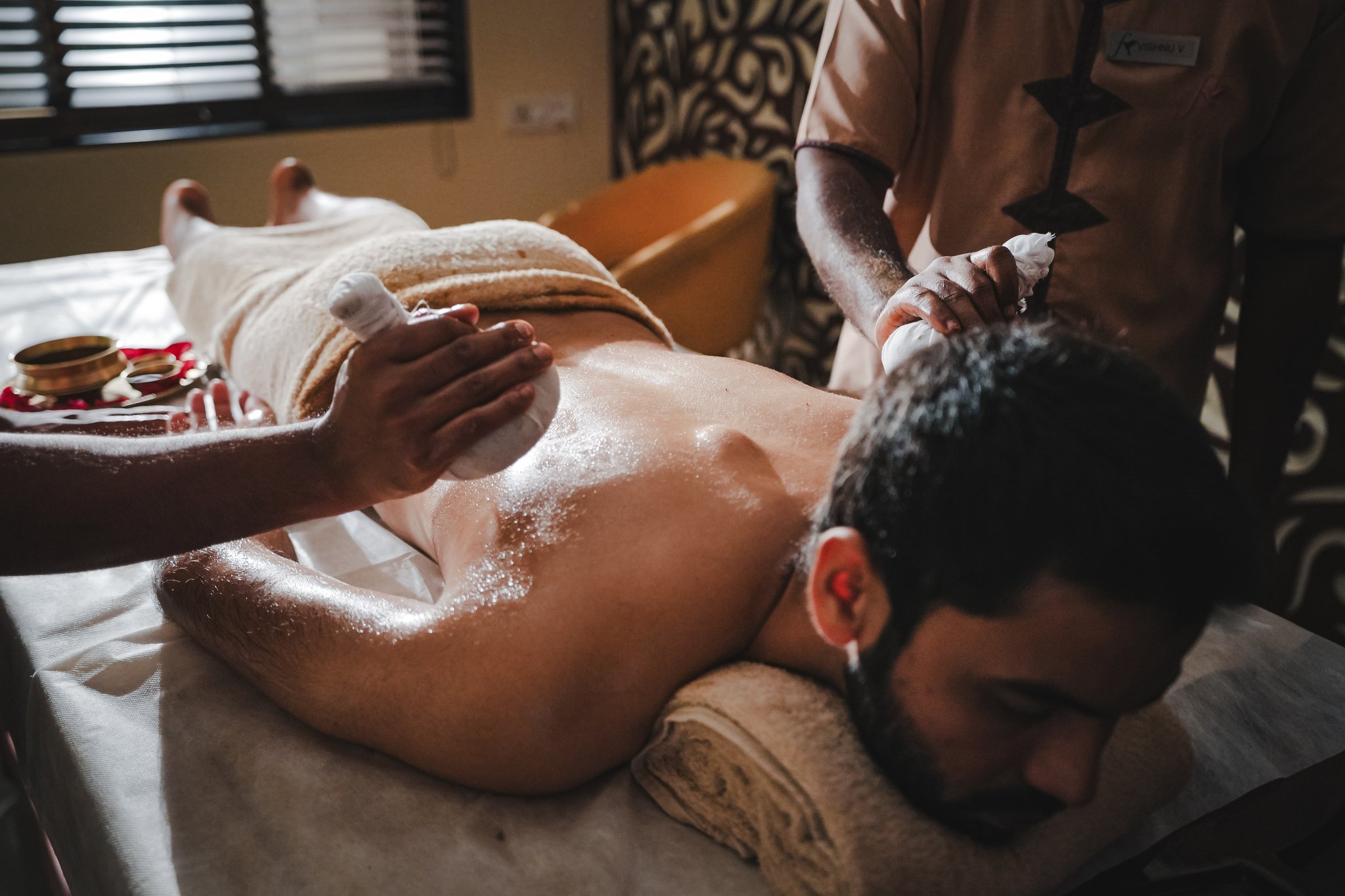
3) Pinda Sweda: warm bolus therapy
A warm bolus (often herbal or rice-based) is used with rhythmic application over the body or a region.
There are different forms:
- Patra Pinda Sweda (herbal leaf bolus) Often used when the pattern needs warmth and movement, especially with stiffness and soreness.
- Shashtika Shali Pinda Sweda (rice bolus) Often used when the pattern needs warmth with a nourishing, rebuilding quality. Many people find it deeply calming.
What it feels like:
- warm, rhythmic contact
- gentle sweating without the intensity of a steam box
4) Upanaha Sweda: poultice or warm paste application
This uses a warm herbal paste or poultice applied to a region and left for a period of time.
What it often supports:
- stubborn tightness
- aches that feel deep and local
- areas that respond to steady warmth over time
What it feels like:
- slow, steady heat
- less “sweaty”, more “soothing”
5) Avagaha Sweda: therapeutic bath or soak
This is soaking a body region in warm herbalised water or a warm bath under guidance.
What it often supports:
- local pain or tightness
- pelvic, hip, lower back patterns in suitable cases
- people who do not tolerate steam well
Heat is not automatically good for everyone
The same therapy can help one person and aggravate another.
The decision is about qualities.
Swedana when Vata is high
Vata patterns often include dryness, irregularity, light sleep, nervous system sensitivity.
Heat can help, and it must be gentle.
Supportive approach often includes:
- shorter duration
- moderate warmth, not extreme heat
- paired with oil work
- steady hydration
- calm rest afterwards
Red flags during heat for Vata:
- dizziness
- dry mouth and sudden exhaustion
- anxiety rising
- sleep becoming lighter afterwards
Swedana when Pitta is high
Pitta patterns often include heat, acidity, irritation, inflammation tendencies.
Heat may be reduced, modified, or avoided.
If used, it is often:
- brief
- mild
- carefully monitored
- chosen for a specific reason, not as a default
Red flags for Pitta:
- overheating
- skin flushing, irritation, burning sensations
- increased acidity or irritability
- restless sleep from heat
Swedana when Kapha is high
Kapha patterns often include heaviness, sluggishness, congestion, low movement drive.
Heat is often more useful here, provided it stays comfortable and safe.
Supportive approach often includes:
- steady warmth
- appropriate duration
- paired with movement and lighter meals
- rest that does not become oversleeping
Red flags for Kapha:
- feeling depleted rather than lighter
- headaches or dizziness from too much heat
- heaviness increasing from overeating after heat
What a well-run Swedana session looks like
A good session is not a performance.
It usually includes:
- a brief check-in (sleep, appetite, energy, current symptoms)
- clear explanation of what type of heat is being used and why
- comfort-based pacing (you can speak up at any time)
- steady monitoring, especially if you are heat sensitive
- rest time afterwards so the body can settle
A good therapy should feel supportive during and after.
Aftercare: where the benefit becomes stable
After heat therapy, the body is more open and more sensitive.
Simple aftercare helps the benefit settle:
- rest quietly for 10 to 20 minutes if possible
- hydrate steadily (not extremes)
- keep the body warm, avoid sudden cold exposure
- eat simply, especially if digestion is sensitive
- avoid intense workouts straight after heat
- protect the evening so sleep can deepen
Try This: safe “Swedana-lite” at home
This is not a substitute for clinical therapy. It is a gentle home practice.
Choose one:
- Warm shower, followed by a quiet sit for 2 minutes
- Warm foot soak for 10 minutes, then socks, lights down
- Warm compress on neck or lower back for 10 minutes
- Gentle walk after meals to support movement and flow
Skip home heat if you are unwell, feverish, or heat reactive.
Ask your Vaidya: questions that keep heat therapy safe and personal
- Why are you choosing Swedana for me, and what pattern are we addressing?
- Which type of Swedana are you using, and why that one?
- How long should it be in my case?
- What should I notice afterwards as signs it helped?
- What signs mean we should reduce or stop heat therapies?
- What should I do after the session to protect digestion and sleep?