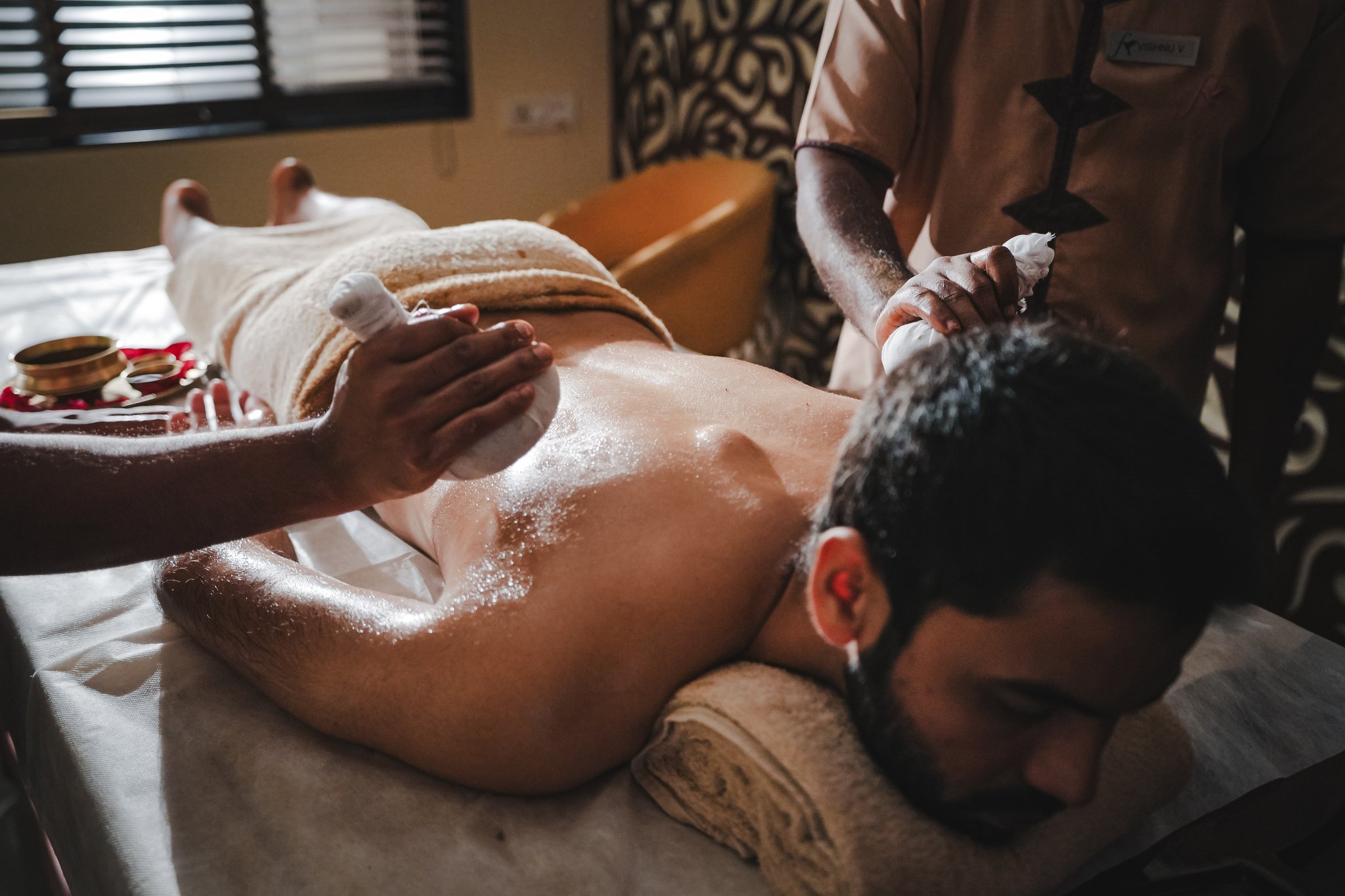
Part 7: The treatment atlas
Ayurveda is often associated with oils, herbs, and cleansing.
Yes, and one of the most practical parts of an Ayurvedic life is something far simpler:
Movement that keeps the body usable.
Not extreme workouts.
Not punishment.
Not “push through pain”.
Just steady, functional movement that supports circulation, joints, digestion, sleep, and mood.
In modern life, many people do not feel unwell because they lack knowledge. They feel unwell because they sit too long, breathe too shallowly, and carry tension so consistently that the body forgets how to let go.
This chapter is a calm, grounded guide to what we mean by “Ayurvedic physiotherapy principles”. Think of it as: how to move in a way that supports healing, rather than competing with it.
A gentle safety note
This chapter is educational. It is not medical treatment.
If you have any of the following, get clinical support first:
- sudden severe pain
- new numbness, weakness, or tingling that is spreading
- loss of balance, fainting, severe dizziness
- chest pain, breathing difficulty
- recent injury, fracture, or surgery still healing
- severe joint swelling, redness, heat, or fever
If movement makes pain sharper, more intense, or unstable, stop and seek professional advice. Gentle should feel safe.
What this chapter means by “Ayurvedic physiotherapy”
Ayurveda has always cared about movement, posture, breath, and function.
Modern physiotherapy is also excellent at diagnosis, rehabilitation, and safe strengthening.
So the mature stance is:
Ayurvedic movement principles support the body’s daily rhythm and recovery.
Modern physio supports assessment and rehab when something is injured or complex.
They can sit together.
This chapter focuses on movement that is:
- gentle
- repeatable
- joint-friendly
- nervous-system friendly
- supportive of digestion and sleep
Principle 1: Function first, flexibility second
A flexible body that hurts is not a win.
Ayurvedic movement aims for:
- joints that move cleanly
- muscles that support posture without constant tension
- breath that stays easy
- daily tasks that feel lighter
If flexibility grows, great.
The real goal is function.
Principle 2: Move little and often
Your body responds more to consistency than intensity.
Small movements repeated daily support:
- circulation and warmth
- joint lubrication
- digestive flow
- mood steadiness
- less stiffness from sitting
If you can only do one thing, do this:
Walk 10 minutes after lunch or dinner.
It supports digestion, reduces heaviness, and improves sleep for many people.
Principle 3: Breath is the steering wheel
When breath is shallow, the nervous system stays in “up mode”.
When exhale lengthens, the nervous system downshifts.
So movement becomes easier when breath leads it.
Try this while stretching or walking:
- inhale through the nose for 4
- exhale through the nose for 6
If that feels too much, shorten it. Comfort matters.
Principle 4: Warm the body before deeper movement
Cold, stiff movement often creates more tension.
Warmth helps tissues soften.
Warmth can come from:
- a warm shower
- a few minutes of walking
- gentle joint circles
- light mobility before any strengthening
If you are dry, under-slept, or anxious, warming first is even more important.
Principle 5: Pain is information, not a test
Ayurveda listens to signals.
In movement terms:
- mild stretch sensation is often fine
- sharp pain is a stop sign
- pain that increases after movement is feedback to reduce intensity
- pain that decreases and movement that feels easier is feedback you’re on the right path
You are not trying to win against your body.
You are trying to cooperate with it.
Principle 6: Strength is built through steadiness, not strain
If you are depleted, anxious, or sleeping badly, intense training can backfire.
A safer sequence is:
- steady routine and sleep protection
- gentle movement daily
- strength work that builds slowly
- more intensity only if the body is stable
That sequence respects ojas.
A simple daily mobility sequence (8 to 12 minutes)
Do this once per day, or split it into two smaller sessions.
- Breath reset (60 seconds)
Sit or stand.
Inhale 4, exhale 6, for 6 cycles. - Neck and shoulders (2 minutes)
- slow head turns left and right, 5 each side
- shoulder rolls, 10 backward, 10 forward
- gentle chest opening, hands behind back or arms wide
- Spine (2 minutes)
- cat-cow on hands and knees, or seated spinal wave, 8 cycles
- gentle forward fold, knees bent if needed
- Hips and legs (3 minutes)
- hip circles, 10 each way
- ankle circles, 10 each way
- calf stretch against a wall, 30 seconds each side
- gentle squat hold supported by a chair, 20 seconds
- Feet and grounding (2 minutes)
- roll foot on a ball or bottle, 30 seconds each
- stand still, feel both feet, 6 slow breaths
This sequence is not glamorous.
It is effective.
A simple strength add-on (2 to 3 times a week)
Only add this if you feel stable enough.
Pick 3:
- wall push-ups, 2 sets of 8
- chair squats, 2 sets of 8
- glute bridge, 2 sets of 10
- standing calf raises, 2 sets of 12
- row with a resistance band, 2 sets of 10
Stop before strain.
Leave the session feeling better than you started.
Movement by pattern (Vata, Pitta, Kapha)
If Vata is high (dry, anxious, irregular, light sleep)
Aim: grounding and steadiness.
Helpful:
- slower movement
- longer warm-up
- walking, gentle yoga, mobility
- strength with low reps and good rest
- warm shower after
Avoid:
- intense late-night workouts
- long fasting plus heavy training
- too much high-impact if joints feel dry
If Pitta is high (hot, reactive, intense, easily irritated)
Aim: cooling and calm.
Helpful:
- walking in cooler parts of the day
- swimming or gentle movement if available
- breath-led yoga
- less competitive training energy
Avoid:
- overheated rooms
- very intense intervals when already stressed
- late workouts that create night heat
If Kapha is high (heavy, foggy, sluggish, stuck)
Aim: gentle activation.
Helpful:
- morning movement
- brisk walking
- slightly more heat and pace, within comfort
- consistency over drama
Avoid:
- heavy dinners then zero movement
- long daytime naps that worsen sluggishness
When to combine movement with therapies
Some of the best results come from pairing:
- oil and heat therapies to soften stiffness
- then gentle movement to keep that softness functional
The rule is simple:
Therapy opens, movement maintains.
Try This: the 7-day “function first” experiment
For 7 days:
- 10-minute walk after one meal daily
- 8-minute mobility sequence daily
- screens down 45 minutes before bed
- dinner a little earlier than usual
Track:
- sleep depth
- morning stiffness
- digestion comfort
- mood steadiness
If those improve, you’ve found a real foundation.
Ask your Vaidya: questions that make movement personal
- Which movement pattern suits my current state best: calming, cooling, or activating?
- Are there any movements you want me to avoid right now?
- Should I prioritise walking, yoga, mobility, or gentle strength first?
- What does a safe 21-day movement plan look like for me?
- How will we measure progress: pain levels, sleep, digestion, stamina, mood?
How Fazlani Nature’s Nest should use these principles
At the Nest, movement should never feel like a performance.
It should feel:
- guided
- safe
- matched to the guest
- supportive of the treatment plan
- realistic to continue at home
The goal is not to do more.
The goal is to help the body become easier to live in.